Thinking about Polish game localization? When indie developers decide to expand into Central Europe, Poland is almost always near the top of the list. It is one of the largest PC and console gaming markets in the region, and Polish players have a strong tradition of expecting native-language support, especially in story-driven RPGs, strategy titles, and indie narratives.
Yet many studios treat Polish game localization as a simple file swap: export a CSV, send it to a translator, import the returned column, and ship the patch. In practice, Polish has several structural and technical quirks that can break your UI, clip dialogue boxes, or make your Steam page read like a rough draft if you do not account for them early
The 25–30% Text Expansion Problem
English is remarkably compact. A two-word button label like Load Game or Quit fits neatly inside almost any HUD element. When translated into Polish, however, sentences routinely expand by 25% to 30% and short UI strings can grow even more.
Consider a few everyday interface examples:
- Settings → Ustawienia (+25%)
- Save & Exit → Zapisz i wyjdź (+36%)
- Inventory Full → Ekwipunek jest pełny (+42%)
- Press any key to continue → Naciśnij dowolny klawisz, aby kontynuować (+64%)
In fixed-width buttons, skill trees, or pixel-art dialogue boxes, this expansion causes text to overflow, overlap icons, or shrink to unreadable sizes. Designing UI containers with flexible padding and telling your localizer the exact character limit for tight HUD elements prevents hours of post-localization UI surgery.
Polish Diacritics and the Pixel-Font Trap
Polish uses nine unique diacritical characters: ą, ć, ę, ł, ń, ó, ś, ź, ż (plus their uppercase equivalents: Ą, Ć, Ę, Ł, Ń, Ó, Ś, Ź, Ż).
Many stylized display fonts (especially free pixel-art, hand-drawn, or sci-fi typefaces) support basic Western European accents (like French é or German ü) while completely omitting Central European glyphs. When a game engine encounters a missing character, one of two things happens:
- The letter disappears entirely („Zapisz grę” becomes „Zapisz gr”).
- The engine falls back to a default system font like Arial for that single letter, creating a jarring visual mismatch mid-word.
Testing your font atlas with a simple pangram [such as „Zażółć gęślą jaźń” (which contains all nine Polish diacritics)] before localization begins takes ten seconds and saves an entire font replacement later.
Grammatical Cases and Concatenated Strings
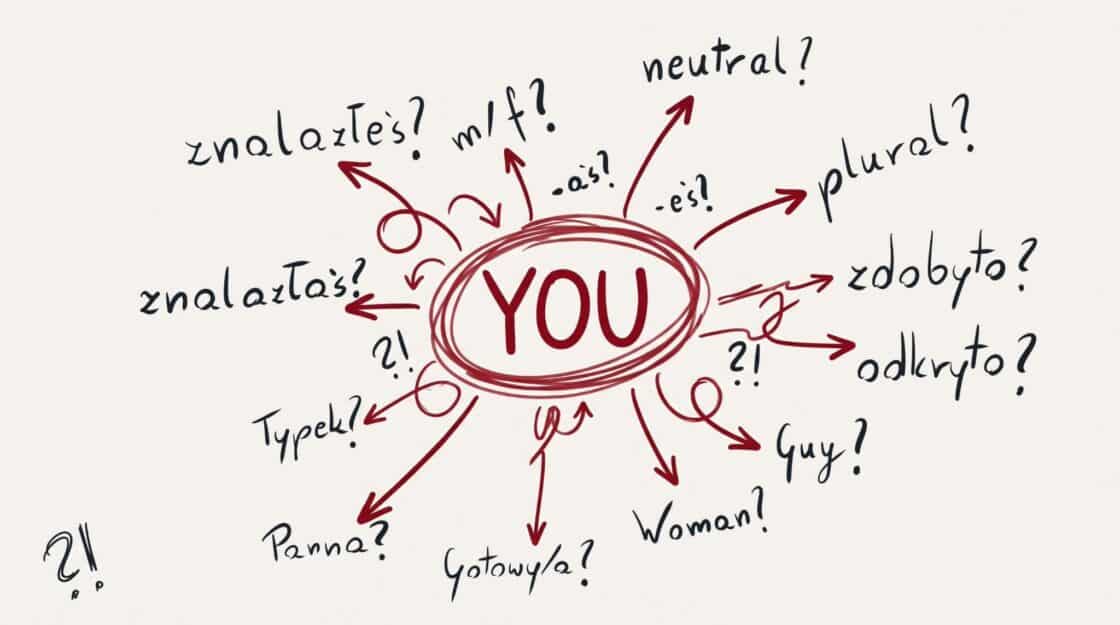
Unlike English, where nouns rarely change form, Polish is a heavily inflected language with seven grammatical cases (nominative, genitive, dative, accusative, instrumental, locative, and vocative). Nouns, adjectives, pronouns, and numerals all change their endings depending on their role in a sentence.
This creates a major headache when developers build sentences out of modular code variables – a practice known as string concatenation:
“You picked up ” + [item_name] + “.”
In English, [item_name] can simply be Iron Sword, Healing Potion, or Gold Key. In Polish, the verb podnieść (to pick up) requires the accusative case, which changes the endings of those nouns:
- Żelazny miecz (nominative) → Podniosłeś żelazny miecz.
- Mikstura leczenia (nominative) → Podniosłeś miksturę leczenia.
- Złoty klucz (nominative) → Podniosłeś złoty klucz.
If your code pulls the base nominative string straight from the inventory database into a dialogue sentence, the result sounds broken to any native speaker. Using full sentence templates with clear variable tags or providing a glossary of item genders and declensions allows the localizer to structure sentences naturally.
Pluralization Is Not Just “One vs. Many”
English localization logic usually assumes two plural states: 1 (singular) and everything else (plural). Polish uses three distinct grammatical forms depending on the number:
- 1: 1 punkt (1 point)
- 2–4 (and numbers ending in 2, 3, 4, except 12–14): 2 punkty, 24 punkty (2 points, 24 points)
- 0, 5–21 (and numbers ending in 0, 1, 5–9, or 11–14): 0 punktów, 5 punktów, 12 punktów (0 points, 5 points, 12 points)
Hardcoding %d points into a single string forces translators into awkward workarounds like Punkty: %d (Points: 5). Implementing proper ICU plural rules in your localization pipeline ensures numbers always read naturally in quest counters, timers, and stats.
Why Your Steam Store Page Needs Adaptation, Not Just Translation
A common mistake among indie studios is translating the entire game into Polish while leaving the Steam store page in English or running the store description through machine translation.
Polish players browsing Steam actively filter by language, and the store page is their first quality check. If the blurb uses awkward phrasing, unnatural word order, or literal translations of English marketing idioms (like rendering „Wishlist now!” word-for-word instead of using the natural Polish Steam convention „Dodaj do listy życzeń!”), players immediately assume the in-game translation was also machine-generated.
Localizing your Steam page, capsule tags, and trailer subtitles alongside the game build builds trust before a player ever clicks Buy.
Final Thoughts
Good Polish game localization is part linguistic craft and part technical preparation. Giving your translator context, checking your font for diacritics, avoiding concatenated strings, and leaving room for text expansion will make your game feel like it was written in Polish from the start.
If you are planning a Polish release for your indie title and want a human-crafted localization tailored to Polish players, take a look at our Polish game localization services
or reach out to discuss your project.