When people think about video game localization, they usually imagine translating fantasy terminology, adapting jokes, or dealing with cultural references. While all of these can be challenging, some of the most difficult localization problems in polish game localization stem from something much smaller: a single pronoun.
One of the most deceptively simple words in English is you. It appears everywhere: tutorials, quest logs, achievement notifications, UI messages, and dialogue. Yet when translating games into Polish, this short and seemingly straightforward word can become a surprisingly complex linguistic puzzle.
The Problem with Simplicity
Consider the following message:
You found a sword.
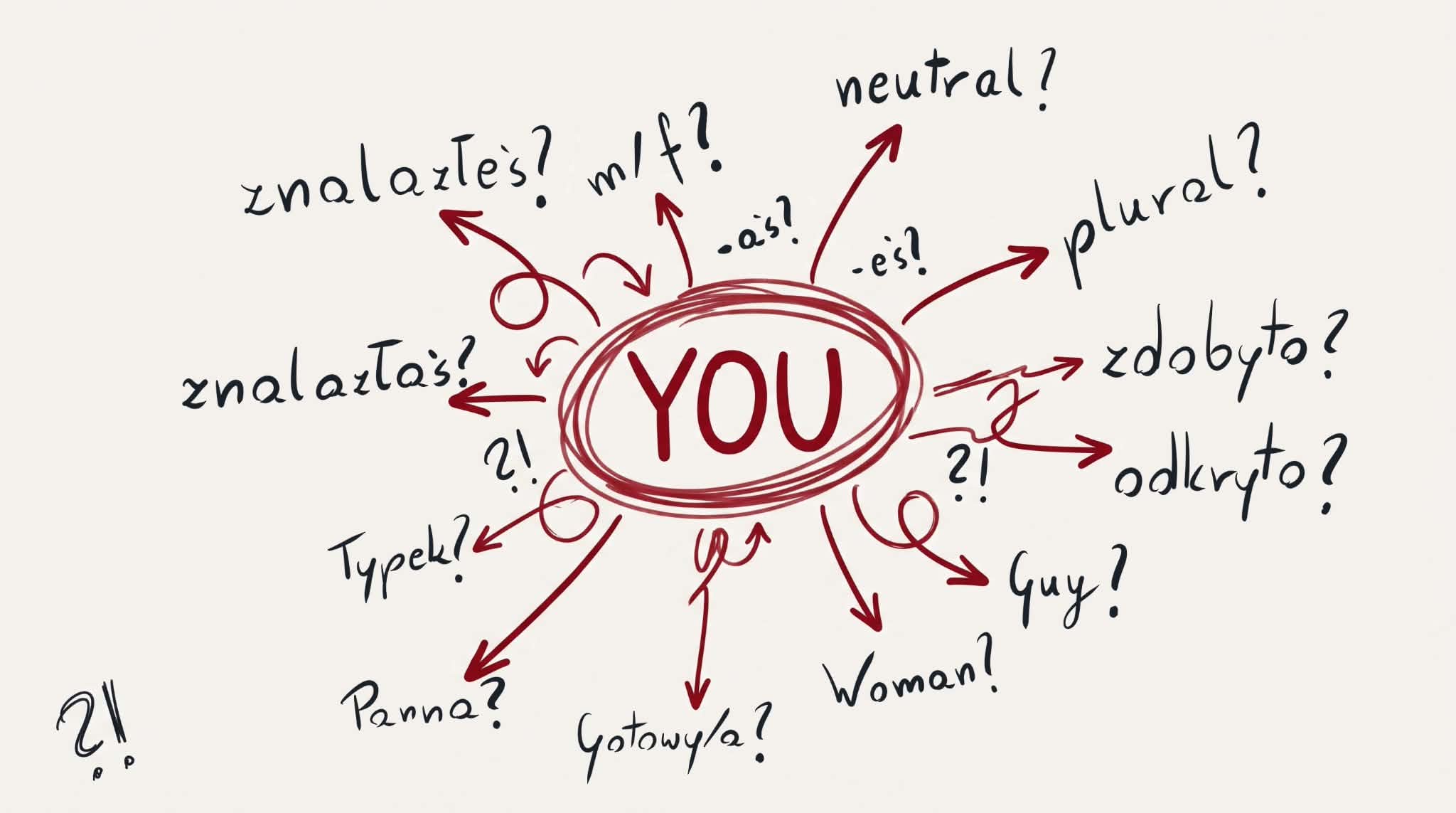
For an English-speaking developer, the sentence is complete and perfectly clear. For a Polish localizer, however, it immediately raises several questions:
- Is the player character male or female?
- Can the player customize their character?
- Is the message addressing the player directly or referring to the protagonist?
- Does the game support non-binary character options?
- Is the message part of the narrative or simply a UI notification?
Depending on the answers, the translation could become:
Znalazłeś miecz. (male version)
Znalazłaś miecz. (female version)
Or perhaps:
Znaleziono miecz.
Zdobyto miecz.
Miecz został odnaleziony.
Each version is grammatically correct. None are identical. The challenge is not finding a Polish equivalent for you. The challenge is determining what information the original text leaves unsaid.
What Languages Must Convey
This problem is closely related to an observation made by Roman Jakobson, one of the most influential translation theorists of the twentieth century:
Languages differ essentially in what they must convey and not in what they may convey.
This distinction is crucial for understanding game localization. This observation perfectly explains why English and Polish approach player communication so differently. English often allows speakers and writers to omit information about grammatical gender. Polish frequently does not.
A sentence such as:
You completed the quest.
suddenly requires information the English original never provided:
Ukończyłeś zadanie. (male version)
or
Ukończyłaś zadanie. (female version)
The English source provides no information about gender. The Polish translation often requires it. As a result, the translator is forced to communicate information that the source text never explicitly expressed.
Translation Beyond Words
Jakobson’s second observation is even more relevant to modern localization:
For us, both as linguists and as ordinary word-users, the meaning of any linguistic sign is its translation into some further, alternative sign.
In other words, translation is not a mechanical process of replacing one word with another. Meaning emerges through interpretation. When localizing games, translators often discover that preserving the player’s experience requires abandoning literal solutions.
Instead of translating:
You received a reward.
a localizer might choose:
Przyznano nagrodę.
Here, the English pronoun disappears entirely. The message remains clear, natural, and functional for every player regardless of gender. The result is less literal but more effective.
When Games Need Multiple Versions of the Same Line
The challenge extends beyond the pronoun you itself. Modern RPGs frequently contain dialogue that changes according to the player’s identity, class, background, or gender. In some cases, developers create entirely separate dialogue variants rather than relying on a single neutral line.
For localizers, this means that a seemingly minor grammatical difference can affect dialogue design, scripting, and implementation. What appears to be a simple line of text may actually require multiple localized versions to preserve the intended player experience.
This is one of the reasons why localization should not be viewed as the final stage of development. Language often interacts directly with game design.
The Challenge Is Not Uniquely Polish
Interestingly, this issue is not limited to Polish. Other European languages face similar hurdles when translating gender-neutral English expressions and comparing how different localization teams solve the exact same line reveals a lot about how grammar shapes narrative design.
In Baldur’s Gate 3, players can choose they/them pronouns during character creation, prompting the dialogue engine to route lines through three conditional branches: MALE, FEMALE, and a default/untagged branch for non-binary characters. In Act 1, a goblin catching the player casting Detect Thoughts (booyahg is goblin slang for magic-user) reacts with three distinct variants depending on the protagonist’s gender:
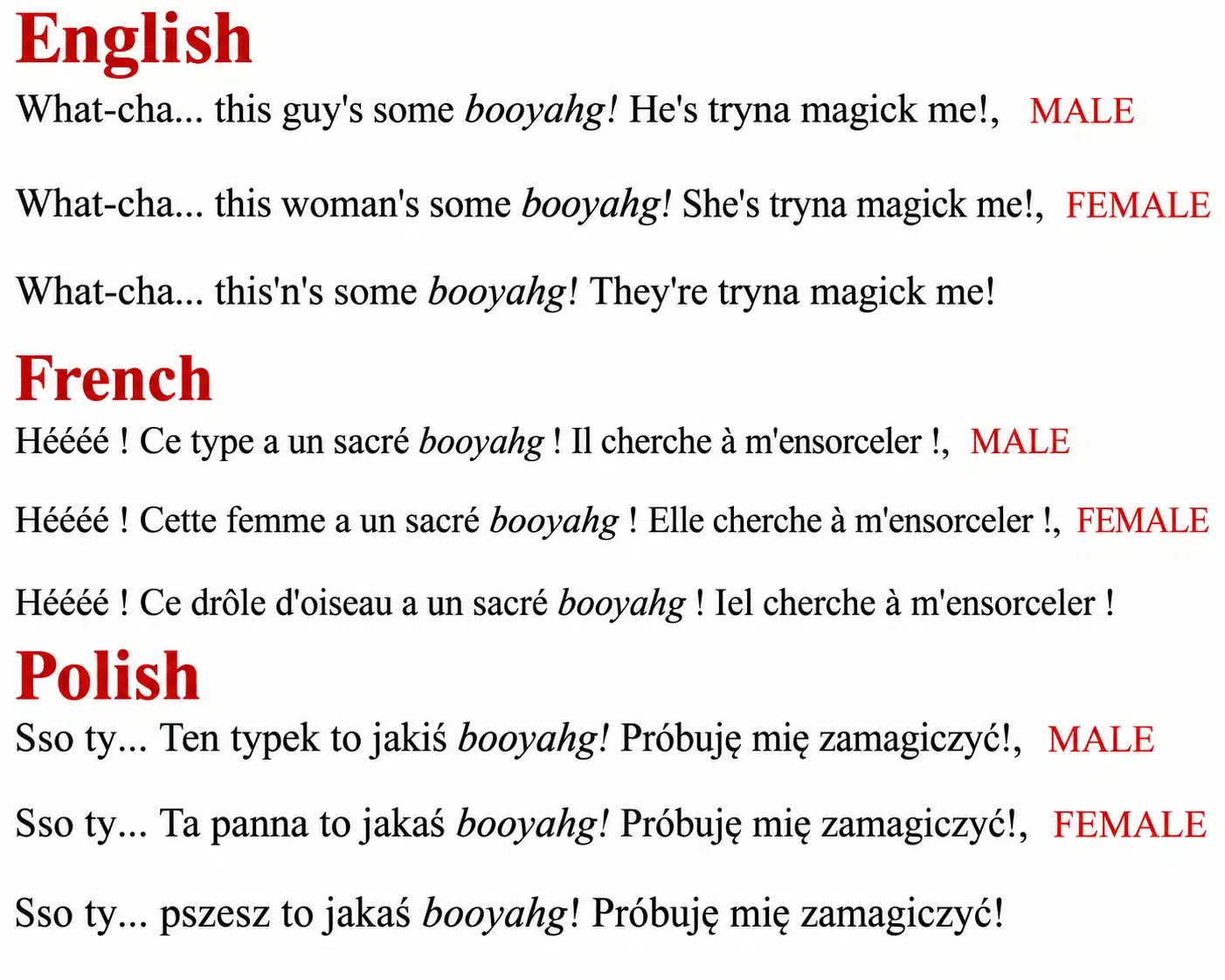
Look at how each language handles the neutral branch without breaking the goblin’s rough, colloquial voice:
- English uses the dialectal contraction “this’n’s” (“this one is”) alongside standard singular “they”.
- French cannot omit the subject pronoun before the verb, so the translator introduces the gender-neutral neopronoun iel (il + elle), while replacing the gendered noun (type / femme) with the idiomatic expression “ce drôle d’oiseau” (“this odd bird/character”).
- Polish, being a pro-drop language, doesn’t need a subject pronoun at all. The present-tense verb “Próbuje” (“He/She/They is trying”) is naturally gender-neutral. Instead of inventing a neopronoun, the Polish translator drops the noun entirely and uses the colloquial particle “pszesz” (a slurred, phonetic rendering of przecież – “why, [this] is some booyahg!”).
This example illustrates how a seemingly simple English pronoun forces localizers to make linguistic decisions that go far beyond vocabulary. The challenge is not merely translating words. It is finding ways to represent identity, voice, and grammar within the structural constraints of each target language.
Why Context Matters So Much
Game localizers rarely work with a complete game build from day one. In many projects, translators receive spreadsheets containing thousands of isolated strings.
A translator may see:
You are ready.
without knowing whether it refers to:
- a warrior preparing for battle,
- a player entering a matchmaking queue,
- a crafting system,
- a tutorial prompt,
- or a character creation screen.
A single line without context can generate multiple valid translations. This is one of the reasons why modern localization workflows increasingly emphasize screenshots, gameplay footage, design documents, and communication between translators and developers. The problem is not linguistic incompetence. The problem is missing information.
Localization Is Communication
A similar perspective can be found in the work of Eugene Nida, whose theory of dynamic equivalence shifted attention away from individual words and toward the effect a message has on its audience.
As Nida argued:
The production of equivalent messages is a process, not merely of matching the parts of the utterances, but also of reproducing the total dynamic characters of communication.
This principle is particularly relevant in game localization. Players do not experience individual words. They experience gameplay. A successful translation therefore reproduces the effect of the original message rather than its exact structure. If removing you creates a more natural Polish version, then removing it may be the correct choice. If rewriting the sentence entirely provides a smoother player experience, that adaptation serves the ultimate goal of localization: effective communication.
What Developers Can Learn from This
Many localization challenges originate long before translation begins. When preparing a game for international markets, developers can significantly reduce costs and improve quality by considering localization early in development.
Even simple measures can help:
- Providing information about character gender.
- Giving translators screenshots and context.
- Avoiding unnecessarily ambiguous UI strings.
- Designing flexible dialogue systems.
- Consulting localizers before text implementation is finalized.
These decisions may seem minor during development, but they have a major impact on translation quality. If you are preparing your game for international release and want to avoid these pitfalls early on, check out our Polish video game localization services to see how we help indie studios adapt their titles for Polish players.
The biggest localization challenges are not always hidden in long dialogue sequences, complex lore, or culture-specific references. Sometimes they are hidden in a single word. For localizers, it is often a reminder that languages do not encode reality in the same way. A seemingly harmless UI string can reveal grammatical, cultural, and design challenges that remain invisible in the source language.
Understanding those differences is not merely a linguistic exercise. It is one of the foundations of successful game localization.
References
- Jakobson, R. (1959). On Linguistic Aspects of Translation. In R. A. Brower (Ed.), On Translation. Cambridge, MA: Harvard University Press.
- Nida, E. A. (1964). Toward a Science of Translating: With Special Reference to Principles and Procedures Involved in Bible Translating. Leiden: E. J. Brill. (See also: Dynamic and formal equivalence).